How to Scale Paid Social Campaigns Using AI‑Generated UGC Creatives: A Practical, Data‑Driven Playbook
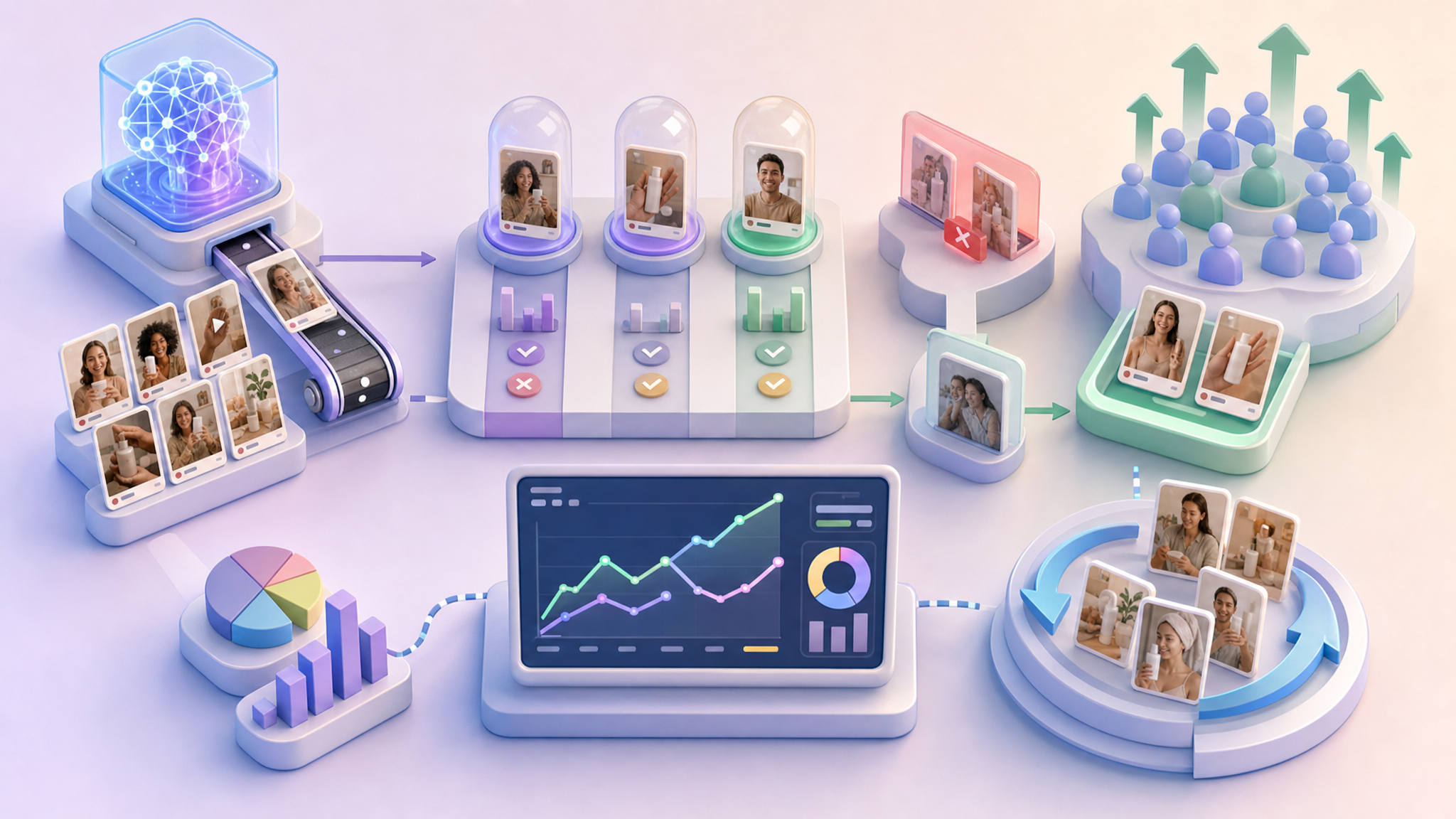
If you want to scale paid social with AI‑generated UGC, run your creative program like a data operation: launch multiple variations per angle (commonly 3–5 to 8–12 at the start), structure one ad set per angle with identical targeting, budget, and placements to isolate the creative, build scripts from a library of winning hooks/personas/CTAs, judge early signals after roughly 500–1,000 impressions per variant (up to 2,000 for firmer reads), pause weak openers (some playbooks use a sub‑25% hook hold rate), cut underperformers within 48–72 hours, move winners into a scaling campaign, allocate 70–80% of spend to proven assets and 20–30% to tests, refresh winners every 14 days or 3–4 weeks, validate with controlled A/Bs measuring ROAS, CPM, CTR, and video completion rate, and protect the brand with approved prompts, banned‑phrase rules, and tiered approvals.
What do “AI‑generated UGC creatives” and “scaling paid social” mean?
- AI‑generated UGC creatives: Performance‑oriented user‑style videos or images drafted or assembled with AI and guided by a structured brief. They’re especially useful for utility‑driven content such as product walkthroughs, feature demos, or localized variants, and when speed or creative volume is a bottleneck.
- Scaling paid social: Increasing spend and reach behind proven creative while maintaining or improving efficiency and customer quality. Scaling is supported when engagement, conversion, revenue, and customer quality all point in the same direction—not engagement alone.
How do you turn AI UGC into a repeatable testing system?
- Build an angle library from recent top performers.
- Audit hits from the last cycle and extract the hook type, persona, and CTA. These become the basis for new AI UGC briefs.
- Structure tests to isolate the creative variable.
- Use one ad set per creative angle with identical targeting, budget, and placements so performance differences come from the creative itself.
- Launch enough variation to learn fast.
- Several guides recommend testing 3–5 variations per ad set at launch; others use 5–10 or even 8–12 depending on capacity and platform norms.
- Generate hooks and scripts in batches.
- Write 3 hooks per angle or generate 5–8 script variations per winning angle to create real differentiation in openers and framing.
- Use performance‑oriented UGC briefs.
- Specify product context, target user/problem, key claims to include, and the required CTA.
- Export for key placements.
- Produce the same creative in multiple aspect ratios such as 9:16 for vertical short‑form, 4:5 for feed, and 16:9 for widescreen.
What hook categories should you test first?
Common, versatile categories include:
- Problem–agitate–solve
- Social proof
- Transformation (before/after or outcome focus)
- Demo/product walkthrough
- Curiosity‑gap
- Price–value
- Objection‑crusher
How should you judge early performance and decide what to cut or scale?
- Give each variant roughly 500–1,000 impressions before reacting; some teams wait at least 2,000 impressions for firmer judgments.
- Some playbooks use a hook hold rate below 25% in the first few seconds as a pause threshold.
- Underperforming creatives are commonly cut within 48–72 hours if early signals are weak.
- Move winners into a scaling campaign quickly, but scale only when engagement, conversion, revenue, and customer quality all support the decision.
- For enterprise validation, run a controlled A/B against existing top performers on major social platforms and track ROAS, CPM, CTR, and video completion rate before full rollout.
What does a strong AI UGC brief include?
- Product context: What the product is and the situation where it’s used
- Target user and problem: Who it’s for and the pain it solves
- Key claims: The must‑say benefits or proof points
- Required CTA: The exact action you want viewers to take
- Angle metadata (from your audit): Hook type, persona, and objections to address
- Guardrails: Banned phrases and claim boundaries
- Approvals: A tiered workflow where higher‑risk claims route through legal before launch
How should you allocate budgets and limit fatigue?
- Budget split: A common rule is 70–80% of spend on proven winners and 20–30% on new tests.
- Refresh cadence: Rotate or refresh winning creatives every 14 days or every 3–4 weeks, depending on channel frequency trends.
- Use AI UGC to quickly spin utility‑driven variants (e.g., demos or localized versions) to maintain freshness without changing the core offer.
A simple, research‑aligned testing and scaling plan
| Phase | What to do | Recommended ranges and rules |
|---|---|---|
| Angle setup | One ad set per angle, identical targeting/budget/placements | Isolates the creative variable |
| Variation volume | Launch multiple variations per angle | 3–5 to 8–12 variations per ad set, based on capacity |
| Hook/script gen | Create differentiated openings | 3 hooks per angle or 5–8 script variations per winning angle |
| Early read | Let the algo gather data | Judge after ~500–1,000 impressions; up to 2,000 for firmer reads |
| Pause rules | Kill weak openers | Consider pausing if hook hold rate <25% in first seconds |
| Cut window | Don’t let losers linger | Cut underperformers within 48–72 hours if signals stay weak |
| Scale criteria | Promote true winners | Move to scaling only when engagement, conversion, revenue, and customer quality align |
| Budgeting | Fund proven, keep testing | 70–80% to winners; 20–30% to new tests |
| Fatigue mgmt | Keep winners fresh | Refresh every 14 days or every 3–4 weeks |
| Validation | Before full rollout | Controlled A/B vs. top performers; track ROAS, CPM, CTR, video completion rate |
What does a weekly workflow look like?
- Monday: Audit prior week’s top creatives; update angle library (hooks, personas, CTAs).
- Tuesday: Draft AI UGC briefs with product context, target problem, key claims, and CTA; apply banned‑phrase and claim boundaries.
- Midweek: Generate scripts (5–8 per winning angle) and export assets in 9:16, 4:5, and 16:9.
- Launch: One ad set per angle with identical targeting/budget/placements; 3–5 to 8–12 variations per set.
- Daily checks: Monitor early signals; pause sub‑25% hook hold rate openers.
- 48–72 hours: Cut underperformers; promote winners to scaling campaign.
- Ongoing: Keep 70–80% budget on winners and 20–30% on tests; refresh winning ads every 14 days or 3–4 weeks.
- Monthly: Run a controlled A/B against incumbents and evaluate ROAS, CPM, CTR, and video completion rate before broader rollout.
Why use AI for UGC in paid social?
- It accelerates the creation of utility‑driven content—product walkthroughs, feature demos, and localized variants—when speed or creative volume is the bottleneck. Combined with disciplined testing and guardrails, it lets you learn faster without sacrificing brand safety.
Frequently asked questions
- How many AI‑generated UGC variations should I test at launch?
- Many teams start with 3–5 variations per ad set; others push 5–10 or even 8–12 depending on platform norms and capacity. The key is enough differentiation to learn quickly.
- When should I kill or pause a creative?
- Gather roughly 500–1,000 impressions before reacting; some teams wait to 2,000 for firmer reads. Some playbooks pause if the hook hold rate falls below 25%, and cut underperformers within 48–72 hours if signals stay weak.
- What budget split should I use while scaling?
- A common rule is 70–80% of spend to proven winners and 20–30% to testing new creative. This maintains growth while continuously sourcing the next winner.
- What is AI UGC best suited for in paid social?
- Utility‑driven content such as product walkthroughs, feature demos, and localized variants—especially when speed or creative volume is the bottleneck.