How to Set Up an AI Pipeline to Auto‑Generate UGC Video Ads from Customer Unboxing Clips
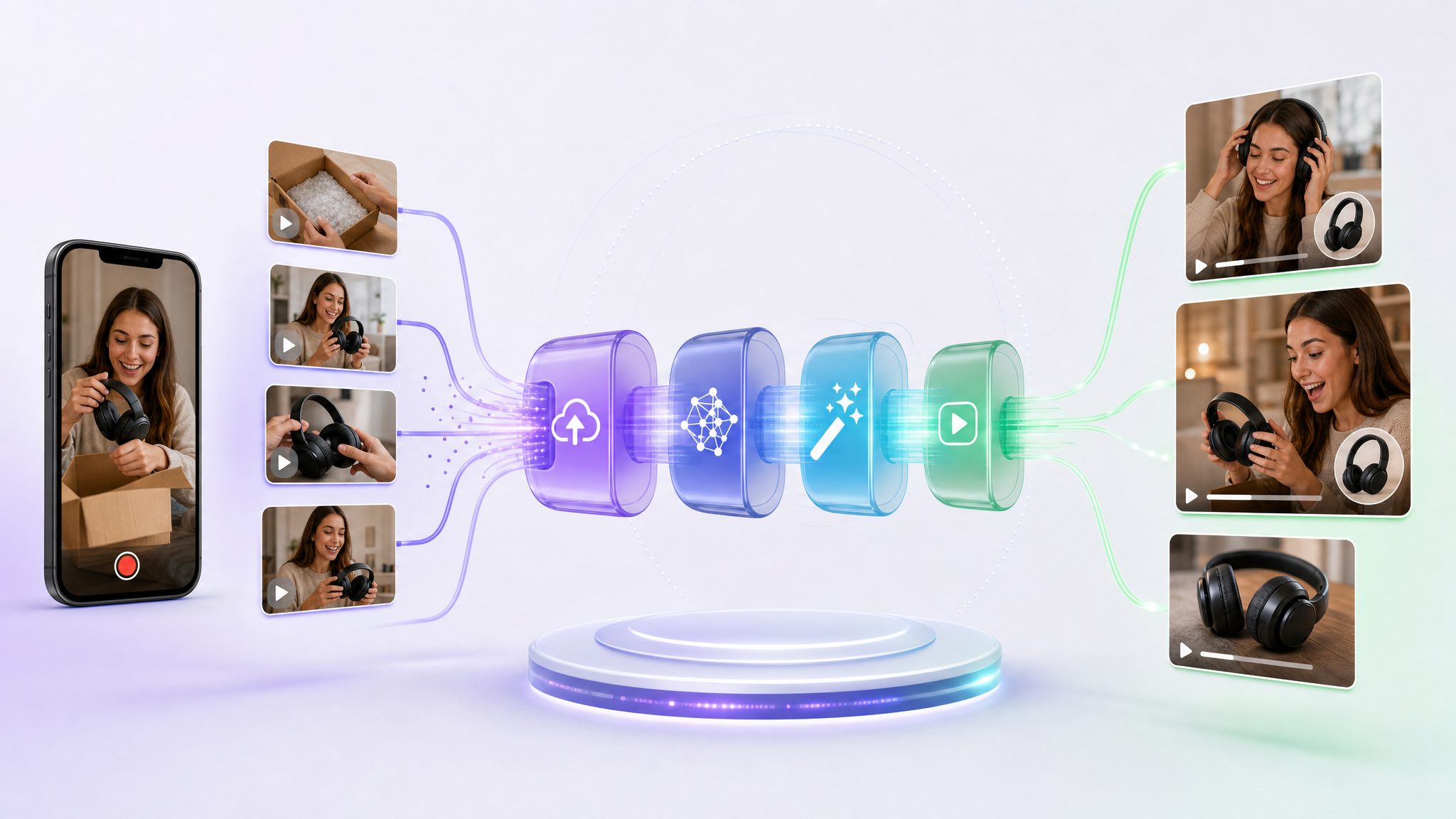
If you already have customer unboxing clips, you can set up an AI pipeline that ingests those assets, transcribes and analyzes them, auto‑writes short UGC ad scripts (Hook → Problem → Solution → CTA), adds a natural voice layer, generates or composes visuals, inserts captions/transitions with fast pacing, and then exports and logs finished ad‑ready videos—automatically orchestrated by agent workflows that pass data between steps and update a tracking sheet.
What is an AI pipeline for auto‑generating UGC unboxing ads?
An AI pipeline for auto‑generating UGC video ads from unboxing content is a chained workflow that handles: asset ingestion, transcription/analysis, script generation, voice/visual generation, editing (captions/pacing), and export/publication. Many modern setups use orchestration or agent workflows to trigger the pipeline, route data between AI models, and write results back to a tracking system such as a spreadsheet.
What does a working end‑to‑end workflow look like?
A common pattern used in current AI UGC systems is:
- Ingest product/customer assets (your unboxing clips, product images, packaging angles)
- Use an LLM to generate ad scripts with a structure like Hook → Problem → Solution → CTA
- Create voiceover with text‑to‑speech or a cloned voice
- Generate visuals (UGC‑style avatars or composited footage around your clips)
- Add captions and transitions, optimize pacing for short‑form
- Output finished ad‑ready clips
Agent workflows often chain these tasks, monitor progress, and update a tracking sheet with final links.
How do I set it up using my customer unboxing clips?
- Ingest your assets
- Upload raw unboxing footage, product images (including packaging and product‑out‑of‑box angles), and a short product description with target audience and key features.
- Transcribe and analyze
- Use an AI transcription step to get a text transcript of the unboxing. Feed that transcript into an LLM to extract the most impressive benefit and any authentic reactions you want to preserve.
- Auto‑generate the script
- Prompt the LLM to output a short UGC ad script enforcing Hook → Problem → Solution → CTA. Keep it concise and authentic for short‑form.
- Add a voice layer
- Generate a voiceover with text‑to‑speech or a cloned voice. Keep sentences short and tone natural to maintain authenticity.
- Generate or compose visuals
- Option A: Edit your original clip with the new voiceover and on‑screen text.
- Option B: Use UGC‑style avatars or stock/AI‑generated visuals synced to the audio.
- Option C: Use frames‑to‑video generation starting from an image of a UGC “actor” holding the product; animate this into a short ad.
- Edit for social
- Add captions, transitions, and pacing adjustments. For TikTok‑style outputs, use 9:16 vertical, 10–20 seconds, and a strong opening moment in the first ~3 seconds.
- Export and track
- Export ad‑ready clips and write the links back to a tracking sheet, updating item status from “ready” to “finished.”
What inputs should I prepare before you automate?
- A concise creative brief: what the product is, who it’s for, and the single most impressive benefit. These inputs drive ad scripts and scene planning.
- Multiple product angles: packaged view and product‑out‑of‑box view; packaging mockups or 3D renders help video models fill visual gaps.
- Desired video type: unboxing, testimonial, review, or explainer. Agent systems can branch style based on your selection.
How do I keep the AI UGC character consistent across ads?
Practitioners define an explicit persona for the AI UGC character—traits, tone, demographic, on‑screen style—so the same personality appears across outputs. A common approach is to describe the character in detail (relatable, non‑robotic, consistent look) and connect a generated influencer image of that character holding the product as the starting frame for frames‑to‑video generation.
How do I automate orchestration and tracking?
- Use an orchestration or agent workflow to: trigger on new assets or a “ready” row in a spreadsheet; pass product data into language, vision, and video models; monitor generation progress; and update a tracking sheet with the final video links.
- One demonstrated setup reads product info (name, photo, target audience, key features, style) from a spreadsheet row, generates a video prompt, calls a video model, and writes the finished link back to the sheet.
- Another working example starts from just a product image and name, uses a vision API to analyze the image, builds an influencer persona, generates multiple short UGC scripts, and creates a video for each script.
What if my raw clips need more visual polish?
- From‑scratch or augmented UGC workflows can download/source base visuals, transcribe them, feed the transcript to an LLM for an ad script, then use frames‑to‑video tools to generate more polished visuals around a UGC actor image. Many systems also provide a storyboard or shot list before rendering—covering beats like hook (sealed package in frame), pattern break (opening motion), hero reveal, detail pass (feature close‑ups), and CTA—so you can revise before generation.
- For refinement, use shot‑level regeneration instead of re‑rendering entire videos. If a single scene has awkward motion, blurry text, or wrong framing, regenerate only that shot with targeted instructions.
Table: The AI UGC unboxing pipeline at a glance
| Step | What the AI does | Typical inputs | Outputs | Automation tip |
|---|---|---|---|---|
| Ingestion | Collects clips and product assets | Unboxing footage, product images, brief | Organized asset bundle | Trigger when a spreadsheet row is marked “ready” |
| Transcription/analysis | Transcribes and extracts key benefits | Raw audio/video | Transcript, highlights | Auto‑summarize to feed script prompts |
| Script generation | Writes UGC ad script (Hook → Problem → Solution → CTA) | Transcript + brief | Short script | Store scripts back to the row for review |
| Voice layer | Generates TTS or cloned voiceover | Script | Voiceover audio | Keep sentences short and tone natural |
| Visuals | Creates UGC‑style visuals (avatars/composites/frames‑to‑video) | Product angles, persona, starter frame | Draft video scenes | Use persona and multiple angles for realism |
| Editing | Adds captions, transitions, pacing | Draft video + VO | Final cut | Set vertical 9:16, 10–20s length, strong hook |
| Export/Publication | Renders and logs output | Final cut | Shareable link | Update status to “finished” in the tracking sheet |
How should I structure hooks and pacing for paid social?
- Unboxing is a high‑performing format in paid social, so mimic authentic unboxing/review behavior—someone holding the product on screen.
- Prioritize the opening ~3 seconds for the hook; if it doesn’t grab attention, iterate the script or opening visuals.
- Keep short‑form outputs vertical (9:16), 10–20 seconds, with fast pacing. Layer AI‑generated voiceover reactions, background music aligned to reveal beats, and on‑screen text callouts for features or price.
Example prompts you can adapt
- Script prompt to an LLM: “Write a short unboxing UGC ad script using Hook → Problem → Solution → CTA for [product], targeting [audience]. Highlight the single most impressive benefit. Keep sentences short and conversational.”
- Shot list prompt: “Propose a 5‑beat shot list: 1) Hook with sealed package in frame, 2) Pattern break with opening motion, 3) Hero reveal, 4) Detail pass with close‑ups of key features, 5) CTA. Note any on‑screen text and transitions.”
Can this run fully hands‑off?
Yes. Tutorials show AI agents that read product data, choose a video style branch (e.g., unboxing vs. testimonial), generate video prompts, call video APIs, monitor progress, and update a tracking sheet with final links. With assets and brief prepared, the loop can run autonomously until human review.
Quick quality checklist before you publish
- Hook lands in the first ~3 seconds
- Persona matches your target audience (e.g., demographic and tone align)
- Voiceover sounds natural; sentences are short
- Captions, transitions, and on‑screen callouts are present and readable
- Vertical 9:16, 10–20 seconds, fast pacing
- Any flawed shot was fixed via shot‑level regeneration
Frequently asked questions
- What’s the best script structure for short UGC unboxing ads?
- Use Hook → Problem → Solution → CTA. This structure is commonly enforced when using LLMs to generate ad scripts.
- Can I automate this from a spreadsheet?
- Yes. Some systems read product info (name, image, audience, features, desired style) from a spreadsheet row, generate prompts, call video models, and then paste the finished video link back while updating status from “ready” to “finished.”
- Do I need real customer footage, or can the visuals be AI‑generated?
- Both are used today. You can edit existing unboxing clips or generate visuals with avatars, stock/AI footage, or frames‑to‑video that animates a UGC actor image holding the product.
- What formats work best for short‑form paid social?
- Unboxing‑style UGC performs well. Optimize for vertical 9:16, 10–20 seconds, with a strong hook in the first ~3 seconds, natural voiceover, captions, and on‑screen feature or price callouts.